Mughsail is a coastal outing west of Salalah, with a long beach and a separate rocky area associated with the blowholes and Al Marnif Cave. A car can make the journey flexible, but it does not make the sea predictable or turn sand into an authorised road. Plan around the places you want to reach on foot, the conditions on the day and the drive back to your actual accommodation. This guide treats the excursion as a modest return journey from a Salalah base, not as a promise of a spectacular water display or a starting point for an improvised off-road expedition.
Choose the coast as the destination, not a guaranteed show
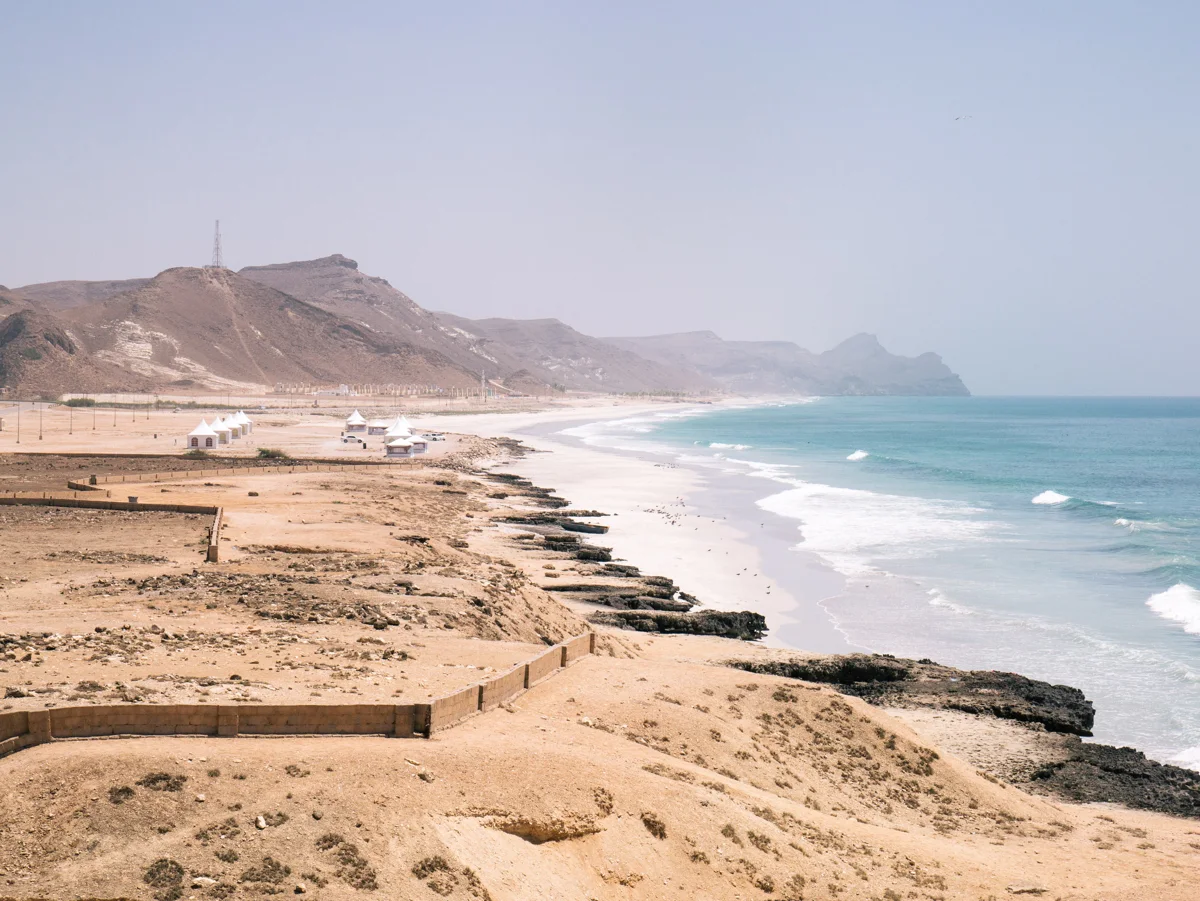
Experience Oman describes Mughsail west of Salalah, a beach stretching about six kilometres and blowholes where seawater is forced through openings in the rock. It places Al Marnif Cave above that area. The effect depends on sea conditions. An old photograph of a large plume does not establish what will happen during your visit, and the attraction should still make sense to your group without that particular spectacle.
Separate your interests before leaving. Some travellers want to look at the coastline, others want time near the recognised viewpoint, and families may prefer a simple picnic. Those are different priorities with different walking and supervision needs. A broad beach name in navigation may not lead to the entrance or parking arrangement most suitable for the part you intend to see.
Do not use stronger surf as a reason to move closer to the water. Observe from permitted areas and follow current barriers and instructions. If a part of the visitor area is closed, keep it out of the plan even when another visitor appears to have crossed a barrier. A scenic outing should not depend on getting the same photograph seen online.
A good fallback is a shorter coastal visit with time to rest back at the accommodation. Agree that option beforehand so a quiet blowhole or an inaccessible viewpoint does not create pressure to drive farther west. The coast can be appreciated without treating every natural feature as an activity that must perform on demand.
Start from your real Salalah address
Set the route from the usable vehicle entrance at your accommodation to the confirmed visitor approach. Salalah airport, a central hotel and accommodation outside the city are not interchangeable starting points. Compare the outward and return routes while stationary, then review any suggested minor connection before accepting it. This page intentionally does not promise a single drive time for every Salalah stay.
If you have just arrived after the long journey from Muscat, make room for rest before another outing. Our Muscat to Salalah road-trip guide compares that intercity journey with flying and renting locally. Mughsail is a separate local decision after arrival, not an extra stop that justifies extending an already tiring driving day.
Save the destination, accommodation and supplier contact details before departure. Download useful map information where possible and check that the phone can be charged in the car. A passenger can manage navigation while the driver watches the road. If you need to change the plan while alone, stop in a suitable place rather than handling the phone in traffic.
Use a simple return outing as the initial plan. Adding another western destination changes distance, road demands and the point at which you turn back. Evaluate that addition separately before leaving Salalah. Do not let a tourism itinerary covering a much larger region become your route merely because the next named place sounds nearby or the road continues beyond your intended stop.
Keep road permission separate from vehicle category
Localrent's Oman conditions restrict rental use to paved public roads and prohibit taking the car across national borders. They also require confirmation at booking for travel outside the province. Check the selected supplier's agreement against your full itinerary, particularly if the same car has come from another part of Oman. A local coastal outing does not resolve permissions for an earlier intercity leg.
Stay with the permitted road approach and use a legitimate parking arrangement. A beach, track or sandy shortcut is not authorised simply because a vehicle can physically enter it. If the last connection suggested by navigation looks unsuitable, stop before committing and seek clarification. Avoid experimenting with unfamiliar ground to reach a viewpoint that can instead be omitted.
A four-wheel-drive label is not an access permit. For a route kept entirely on suitable authorised public roads, compare cars around passengers, luggage, comfort and the actual offer rather than a scenic photograph. The Oman sedan and 4WD comparison explains why drivetrain and contractual permission answer different questions. Do not pay for a larger vehicle expecting it to remove every restriction.
Ask the supplier a specific question when unsure: name the destination, describe the intended road approach and explain any proposed onward travel. Keep the reply with the voucher. General enthusiasm about sightseeing is not the same as confirmation for a doubtful road. If the answer does not establish a suitable plan, choose a different excursion or an appropriately arranged guided option.
Find a lawful parking place before walking
Follow current signs for the part of Mughsail you are visiting and confirm the parking arrangement on arrival. This guide does not verify a particular bay, charge, space count or opening schedule. The beach and the rocky viewpoint should not be treated as one identical arrival point. Identify where you will leave the car and how the group reaches the intended visitor area before unloading.
The Ministry of Heritage and Tourism's visitor guidelines ask travellers to use designated parking and paths. Apply that distinction even when open land appears available. Avoid obstructing access, stopping on an exposed road edge for a photograph or driving onto sand to shorten the walk. The presence of other cars does not by itself prove that a location is permitted.
Look at departure as well as arrival. A space can become difficult when more vehicles arrive, and an uneven edge can be harder to judge from the driver's seat than it first appears. Keep enough room for passengers to enter and leave safely. If the marked arrangement does not suit someone in the group, ask for assistance or an appropriate alternative rather than creating an unofficial drop-off point.
Save the car's position and agree where to meet if the group separates. Bring essential items with you and keep the vehicle locked. An archival beach photograph in this guide shows the setting, not today's parking access. Current instructions at the location take priority over a picture, a cached map or a description written during another season.
Treat the viewpoint and sea conditions as separate checks
A coastal viewing area is not automatically a swimming place. Assess current official warnings and local instructions, and do not assume that an attractive sandy shore has a lifeguard service or safe conditions. The Civil Defence and Ambulance Authority's Khareef safety guidance warns visitors against swimming at beaches during the rough seasonal sea conditions. That is a seasonal warning, not a claim that a quiet-looking day outside Khareef is automatically safe.
Keep children close and agree clear boundaries before approaching the rocky area. Watch the walking surface and maintain distance from edges and spray zones. Do not climb beyond a barrier to obtain a clearer view, stand over an opening or follow another person's attempt to get wet. The force and timing of water are not under visitor control.
For anyone with limited mobility, confirm the route from the permitted parking area to the part you wish to visit. Ask about gradients, steps, surfaces and any current restriction. A cave described as a scenic shelter is not proof of a step-free route or a place suitable for every traveller. Keep the option of a shorter, accessible outing without making someone wait alone while the rest of the party disappears.
A weather forecast and the visible sea answer different questions, and neither cancels an official closure. Check before leaving and be prepared to shorten the visit if conditions change. If the group cannot comfortably use the permitted route, return to the car and choose another plan. The drive has still delivered a view of the coast; there is no need to force the final stage.
Give Khareef and other changing weather real space
The Ministry's activities booklet highlights fog, rain and animals on roads during Khareef, together with vehicle and fuel checks. Those cautions are relevant to a Dhofar itinerary, but a seasonal description is not today's road report. Look at the current forecast and any access warning for the actual route, not just the conditions visible from your hotel window.
If visibility becomes poor, reduce the demands of the day rather than trying to keep the original sightseeing schedule. Follow official directions and do not cross a flooded road or wadi. Choose a lawful safe stopping arrangement when you need to reassess. Do not replace a closed coastal stop with an improvised mountain road simply because the rental period has already been paid for.
Outside the green-season imagery, prepare for the conditions that actually apply: heat, sun, wind or a dry landscape may change what the group finds comfortable. Bring enough drinking water, suitable clothing and basic supplies without depending on a particular beach business being open. Ask about any service essential to your group before setting out, especially when travelling with children or someone with specific needs.
Build flexibility into bookings around the excursion. A fixed meal reservation or a tight return appointment can make a sensible weather-related change feel costly. Keep optional plans optional and contact the relevant provider if an agreed time must change. Rental terms, attraction access and the weather are separate parts of the decision, even when they affect the same afternoon.
Budget the complete excursion without invented prices
Start with the rental offer for the actual period, then add the road use you expect rather than assuming every kilometre is included. A limited mileage allowance must cover the return and other local driving during the rental. Include confirmed delivery, equipment and additional-driver charges where relevant. A low headline day rate does not describe the full cost of an outing from a particular hotel.
Use the vehicle's stated fuel type and a sensible consumption estimate to build a budget, while recognising that real consumption varies. Do not treat an old fuel-price quotation as current. Confirm the return-fuel rule and leave time to meet it before the rental ends. A short sightseeing day can still become inconvenient if refuelling is left until the handover deadline.
Keep parking, food and any separately arranged activity as their own items. Do not assume the tourism page's description of picnic shelters means a guaranteed vacant place or a bookable service. Carry a simple fallback meal if that suits your group, and dispose of rubbish properly. A flexible picnic should not depend on claiming a place that is unavailable or restricted when you arrive.
For payment and security questions, use the Oman deposit and insurance guide alongside the selected offer. No deposit, no excess and no credit-card requirement are different conditions. This outing does not establish any of them. Compare Oman rental options only after deciding which collection point, dates and practical requirements fit the trip.
Finish with a deliberate return to Salalah
Before leaving the visitor area, allow the driver a rest and check the route back to the actual accommodation. Review fuel, passenger comfort and any new weather information. Do not accept an unfamiliar return shortcut merely because the navigation estimate is shorter. The suitable outward road remains a useful reference, subject to current signs and conditions.
If something is wrong with the car, contact the supplier through the verified details and follow its instructions. Keep people away from traffic and do not attempt an unfamiliar repair to preserve the itinerary. A new warning, damage or inability to continue should be handled as a vehicle issue, not as a problem to hide until the end of the rental.
A successful Mughsail day does not require a long list of additional stops. A clear arrival, a comfortable coastal visit and an unrushed return are enough. Keep the evening and any later airport journey realistic, and save wider Dhofar exploration for a day whose route, permissions and conditions have been planned in their own right.
Questions & answers
Are the Mughsail blowholes guaranteed to produce large fountains?
No. The effect depends on sea conditions. Plan a coastal visit that is worthwhile without a particular display and stay within permitted viewing areas.
Can I drive the rental onto the beach?
Do not assume that. Localrent Oman conditions limit travel to paved public roads; vehicle category does not create an exception.
Is this an itinerary from Muscat?
No. It is a local return outing from a Salalah base. The Muscat-Salalah journey requires separate time, mileage and supplier-permission planning.