The National Museum is a useful reason to drive into Old Muscat, but it should be planned as a museum visit followed by a walk, not a circuit of palace and fort entrances that may not admit visitors. The main decisions are straightforward: identify the correct building, check the day's opening, find permitted parking and leave enough time inside. A rental car is useful when the museum fits a wider Oman journey; for a single urban outing, compare the complete taxi or transfer arrangement before adding a rental solely for this stop.
Set the destination to the National Museum in Old Muscat
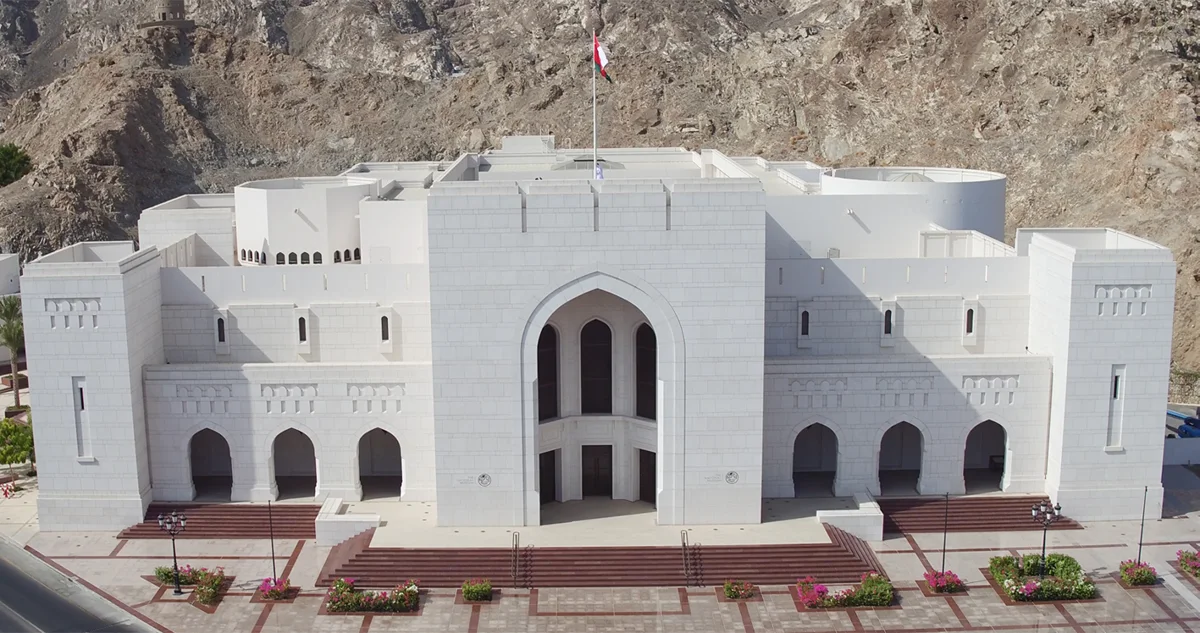
The museum operator locates the building on as-Sa'idyyah School Street, opposite Al Alam Palace in the Wilayat of Muscat. Use the National Museum's own location rather than a broad Muscat city-centre result. A search for museums can also return other institutions with different entrances and collections. Save the full name and destination while you have a reliable connection, then review the final approach before leaving your accommodation.
Treat the museum, the palace-facing public area and any other attraction as separate places. Their proximity does not create a combined admission or a promise of access. If you want a photograph of the palace exterior, decide when that walking stop fits around the museum rather than driving from one map pin to the next. Keep the location of your parked car saved as well as the attraction pin; the place you enter a building is not necessarily where you will return to the vehicle.
Use the opening day to shape the itinerary
On the operator's FAQ checked on 5 November 2026, Saturday to Thursday hours are 10:00–17:00, with the ticket desk closing at 16:30. Friday is different: 14:00–18:00, with ticket sales ending at 17:30. Recheck the official visit page before departure, particularly around holidays and special events. Do not copy a morning plan onto a Friday simply because the building appears in an all-day sightseeing list.
Last ticket time is a limit on admission, not a recommendation for when to arrive. Decide how much time your group wants inside, then work backwards through parking and the walk to the entrance. If you have a flight or a distant hotel afterwards, set a departure time too. For a Friday visit, a late lunch and the museum can be a coherent afternoon; an early arrival at a closed door followed by improvised extra driving is less useful. Keep one optional stop rather than filling every available hour.
Separate the driving route from the parking decision
A navigation route answers how to reach an area, not where you are authorised to leave the car. On arrival, follow current signs and any staff directions. Do not assume the palace-facing space, an entrance forecourt or a convenient roadside gap is public parking. If the first apparent option is unsuitable, continue to a permitted alternative and allow a longer walk. Avoid stopping in a traffic lane while a passenger searches for parking information.
Before leaving the vehicle, check restrictions, payment instructions and the time you may remain. Photograph a sign if it helps you remember the terms, without treating a photograph as permission to ignore them. Note the walking route back, especially if the group plans to leave through a different exit. No space or parking tariff is guaranteed by this guide. For a visitor who needs a particular accessible arrangement, contact the museum first rather than relying on the availability of a general parking bay.
Ask specific accessibility questions before driving over
The museum's FAQ confirms an accessible parking area and an accessible lift. Those are useful starting facts, but they do not answer every person's needs. Ask which entrance to use, how to reach it from the designated parking and whether any temporary works affect that route. Mention the equipment you use and whether assistance is required. A general description of a venue as accessible is less informative than a confirmed arrival sequence.
Coordinate the rental car with that sequence. Check that mobility equipment fits with the passengers aboard and that there is room to unload it without entering moving traffic. If one person drops others off before parking, agree exactly where the group will wait and how the driver will find them. Do not promise a step-free route around the neighbouring outdoor sights merely because the museum has a lift. Their surfaces and access arrangements need their own check, and they can be omitted without compromising the museum visit.
Confirm payment and admission for each visitor
The operator's FAQ currently specifies Visa and Mastercard payment. Check current admission categories and payment arrangements directly before travelling; nationality, residency and concessions should not be inferred from another member of the group. Bring the documents needed to establish any category you intend to use. A relative's residency does not automatically make the whole party eligible for the same admission rate.
Keep museum admission separate from parking, transport and any guided service. A quotation from a driver may include only the journey, while a packaged excursion may describe a different set of inclusions. Ask what is actually covered before comparing totals. If paying at the venue, retain the receipt until the visit is complete. Avoid assuming that a rental booking, a hotel recommendation or an attraction listing acts as a museum ticket. Each service has its own confirmation, and one provider cannot necessarily resolve a payment problem with another.
Give the galleries the main part of the visit
Once inside, orient yourself using the museum's current map and staff advice. Choose the parts that interest the group most before attempting to see everything. A visitor interested in maritime connections may want a different pace from a family looking for a shorter introduction to Oman. Treat the museum's own labels and interpretation as the authority for objects and historical detail rather than using a driving guide as a substitute for the exhibition.
Agree a meeting point if people explore at different speeds, and keep enough time for everybody to return before the driver needs to leave. Check rules about photography, bags and any special exhibition when entering. Do not assume a temporary display will still be present because it appears in an older review. If the group starts to tire, reduce the remaining outdoor programme rather than rushing the museum simply to preserve a long list of additional stops. The car gives flexibility; it need not turn the day into a race.
Add a short Old Muscat walk only when it fits
The museum's setting opposite Al Alam Palace makes the surrounding area a natural possible extension. Decide what you intend to do: see an exterior, take a brief walk or visit another institution with its own admission. Those are different plans. Do not assume that every prominent fortified building is open for casual entry, and do not enter restricted areas for a better view. Follow current boundaries and signs even if a photograph online shows somebody closer.
Keep the walk's return point connected to the parked car. In hot weather, a short-looking distance can feel different after time outdoors, so carry water and allow a pause before driving. If some travellers remain at a cafe or the museum while others walk, agree a clear reunion time. It is usually easier to shorten this optional part than to move the car repeatedly. A useful visit can consist of the museum and one exterior viewpoint without collecting every nearby name on a map.
Do not confuse Old Muscat with a full Muttrah visit
Muttrah is another destination to plan, not simply the next room of the museum. If you want the souq, corniche or fort, allow a separate arrival and parking decision. Decide whether the group genuinely wants another substantial visit after the galleries. The Muttrah Fort driving guide explains a different access problem involving an outdoor historical site; it should not be read as an included extension of museum admission.
A practical combined day has a priority and an optional part. For example, protect the museum time and add a shorter Muttrah stop only if the driver and passengers still want it. Alternatively, give each area its own day when the accommodation and rental period allow that. Avoid making a fixed restaurant reservation depend on an optimistic sequence of parking, museum queues and another attraction. The flexibility to drop a stop is more valuable than a tightly packed itinerary that leaves no room for ordinary delays.
Consider whether this works on an airport arrival day
A museum visit can look convenient after landing because it is an indoor activity, but the arrival process still comes first. Allow for immigration, bags, the agreed rental handover, checking the vehicle and reaching accommodation. If the driver is tired or the group needs to rest, postpone sightseeing. An arrival time printed on a flight schedule is not the time you will be ready to start a museum visit.
The Muscat airport car rental guide covers the practical collection sequence. Before adding the museum, decide where luggage will be kept and whether the car can be unloaded at the hotel. Do not build a long sightseeing stop around leaving travel documents and valuable bags unattended in a parked vehicle. A later visit after check-in is often easier to organise, but its suitability depends on the day's opening hours and your actual energy, not on a universal rule about arrival days.
Choose a car for the wider trip, not the museum building
The museum is an urban destination; visiting it does not itself establish a need for a four-wheel-drive vehicle. Choose from the Oman car catalogue according to the complete itinerary, passenger and luggage requirements, transmission preference and the conditions of the particular offer. If later days involve destinations with specific vehicle requirements, investigate those separately before booking. A city museum visit cannot validate a mountain or off-road route.
At collection, check visibility, controls and the equipment needed by everyone travelling. A compact vehicle may be easier to manage in some parking situations, but it still needs adequate capacity and comfortable seating. Do not accept an unsuitable car merely because this day's drive looks straightforward. Keep the supplier's permitted-road and driver conditions with the booking. For a city-only visit, compare the total rental and parking arrangement with a confirmed taxi or transfer, including how you will return rather than only the price of getting there.
Protect the onward journey and the rental return
If the museum is your final stop before leaving Muscat, work backwards from the real return appointment and the airline's requirements. Include the walk back to the car, loading, fuel, the supplier's return entrance and any transfer to the terminal. A museum closing time is not a safe departure target for every flight. Set a latest time to leave the galleries and keep the outdoor extension optional.
For a continuing road trip, check the next accommodation's arrival arrangements before spending longer than expected in the museum. Do not turn a relaxed indoor visit into an uncomfortable late drive simply to preserve an earlier plan. The Muscat stopover guide helps separate a short city stay from an ambitious multi-stop circuit. If the rental period needs changing, contact the supplier through the booking's verified details before the agreed return time. Continued possession of the keys is not an approved extension.
Keep a small checklist rather than a minute-by-minute schedule
Before leaving, confirm the museum's current opening and last admission, the correct location, your payment method and any accessible arrival arrangement. Save the parked-car location after arrival. Choose the main purpose of the visit and a time to leave that protects the next commitment. Those few decisions do more for the day than a schedule that assumes every traffic light, queue and walking pause will take exactly as long as predicted.
Keep the official museum page available for changes. This guide's hours and service details were checked on 5 November 2026; they are not a live operational feed. If a closure or event changes the plan, choose another day or a separately verified activity rather than assuming another museum has identical opening and ticket rules. The successful car visit is simple: a suitable vehicle, a permitted place to park, enough time in the galleries and an onward journey that remains comfortable when the visit ends.
Questions & answers
Is the museum open on Friday morning?
The operator's FAQ checked for this guide lists Friday opening at 14:00, unlike the 10:00 opening Saturday to Thursday. Recheck for your date and any holiday exception. Do not plan a Friday morning museum stop solely from a generic daily itinerary.
Does the museum provide accessible parking?
The museum says it has an accessible parking area and a lift. Contact it for the exact arrival route and any assistance or temporary restrictions relevant to your needs. This does not establish step-free access to every nearby outdoor attraction.
Can I visit the palace with the same ticket?
Do not assume so. The museum and neighbouring landmarks have separate access arrangements. Plan any exterior walk separately, follow current boundaries and verify admission directly for another venue rather than treating proximity as a combined ticket.
Is a car necessary for this one visit?
Not necessarily. Compare a confirmed taxi or transfer and return arrangement with renting, parking and collecting a car. A rental may make more sense as part of a wider Oman journey; one museum visit alone does not establish the best transport choice.