Nakhal Fort is a useful focus for a heritage day outside Muscat when you want a specific visit rather than a long list of mountain stops. The fort belongs to Al Batinah South and stands on a rocky outcrop above palm groves. Planning the outing means checking more than a driving estimate: confirm the rental's permitted route, current admission and the walking involved, then decide whether the nearby springs deserve a separate stop. Keep the return to your actual accommodation in the plan from the beginning.
Choose Nakhal for the visit, not just the drive
Experience Oman describes a fort built around natural rock, with rooms, defensive towers and views across the surrounding landscape. That makes it a different outing from a beach stop or a shopping visit. Decide whether your group wants time to explore the building, take photographs and understand its setting before allocating the day to the journey.
You may see the name written Nakhal or Nakhl. Confirm that the navigation result is the fort in Al Batinah South, not simply a town search or another similarly named attraction. Save the visitor arrival point and check the current entry arrangement. A pin at the centre of a historic building is not necessarily the correct place to approach by car.
This itinerary is deliberately centred on one fort. It does not assume that every visitor wants to complete a circuit of forts, springs and mountain villages. A slower visit can be a better use of the rental than driving between several sites without enough time to enter any of them properly.
Check permission for the trip beyond Muscat
Localrent's Oman terms require travellers to confirm travel outside the province during booking, because conditions can vary by rental company. Describe the intended Muscat to Nakhal outing clearly and obtain confirmation for the selected car. A broad advertisement for Oman rental is not the same as approval of every route or a particular regional journey.
The published terms also restrict use to paved public roads. Review the full proposed route rather than relying only on a destination name. A navigation shortcut, optional village detour or track beside a wadi can change the nature of the journey. Buying a larger vehicle does not remove the agreement's restrictions.
Begin at the Oman car rental catalogue with your actual dates and collection location, then resolve route questions before committing. Vrenty Car provides affiliate information, Localrent handles the reservation and the selected company supplies the car. Neither this article nor a map recommendation can grant an exception on the supplier's behalf.
Build the journey from your actual Muscat address
Muscat is not a single pickup point. Use the accommodation's vehicle entrance or the agreed rental office as the route origin, then add the correct fort visitor approach. Review the return to the same address separately. A general Muscat-to-Nakhal estimate does not include leaving a particular property, collecting the car or finding the arrival point.
Keep the first departure straightforward if this is your first day with the vehicle. Learn the controls and arrange navigation while parked, then follow the approved route. If an unexpected diversion appears, reassess before following it into unfamiliar terrain. There is no need to preserve an ambitious schedule by accepting a road you have not checked.
The Muscat driving and parking guide covers preparation for the urban part of the day. The same attention matters on return, when you may be tired and trying to find a hotel entrance in different traffic conditions. Save that entrance rather than a generic district or a pedestrian reception pin.
Confirm admission separately from the outside view
A fort visible from the town can still have specific visitor hours, ticket arrangements and areas that are not accessible on a particular date. Check the current official visitor information before leaving and confirm any detail essential to your visit. Do not treat an old review mentioning a closed gate as a permanent closure, or an old opening schedule as a guarantee.
Experience Oman identifies on-site ticket purchase and guided visits on request. If a guide is important, ask about availability and language in advance rather than assuming one will be waiting when you arrive. Likewise, clarify any group arrangement, concession or payment question before building the rest of the day around a fixed entry time.
This guide intentionally does not lock a ticket price or daily closing time into the itinerary. Leave enough time before the confirmed last admission to enjoy the visit, not merely to reach the gate. The outward drive and the time you want inside are separate parts of the schedule.
Plan for a building with levels and stairs
The official description distinguishes two main floors and towers, so do not judge the physical visit only from the distance between the car and entrance. Ask which areas are open and what access involves. A general accessibility label does not establish that every room, terrace or tower is step-free or suitable for every visitor.
For a traveller with mobility limitations, ask concrete questions about the drop-off, entrance, steps and a shorter visit. Explain whether the difficulty is walking distance, standing, stairs or transporting mobility equipment. Those details make it easier to decide whether the fort offers a satisfying visit for the whole group without making unsupported accessibility promises.
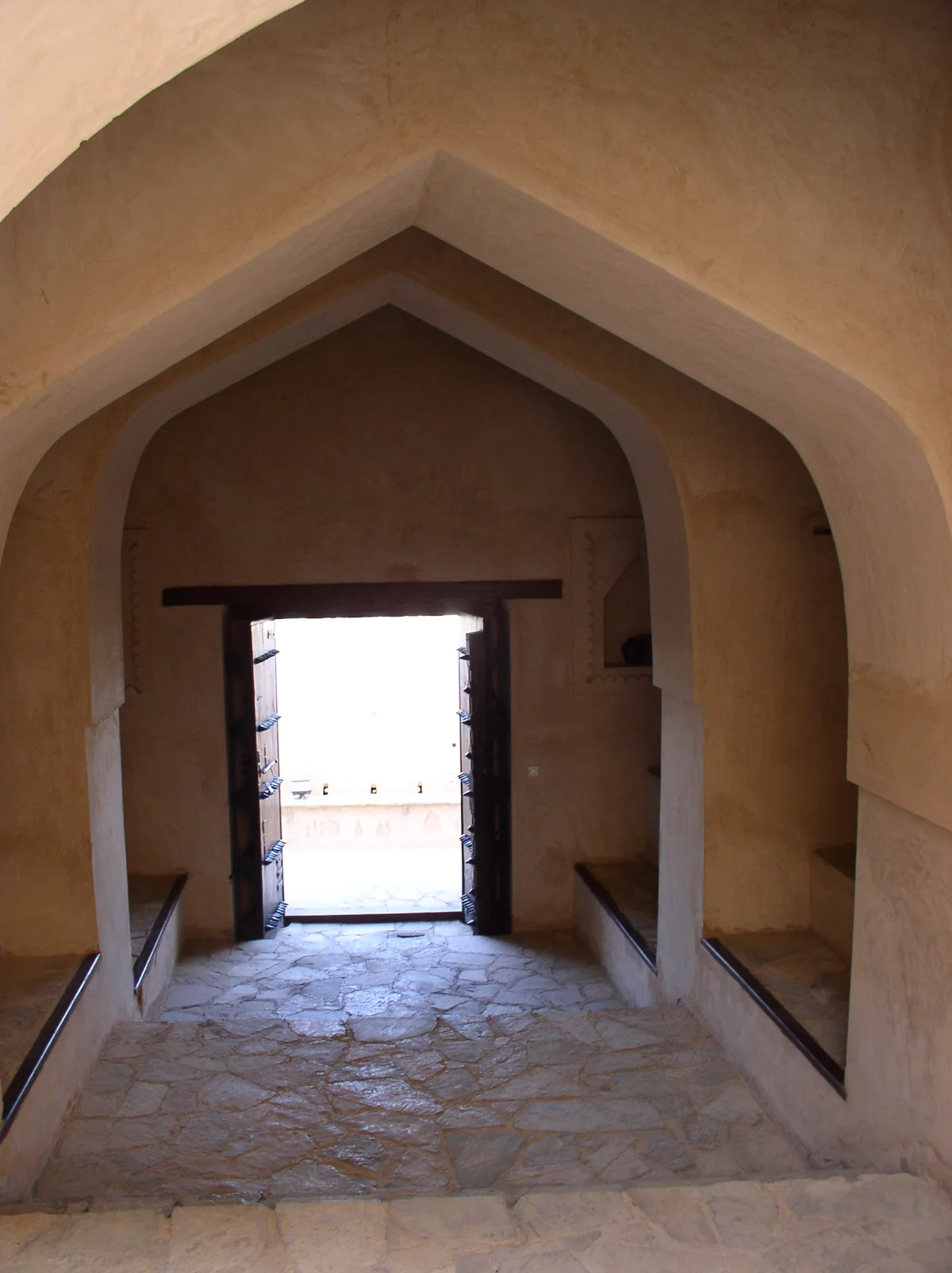
With children or mixed walking speeds, choose a meeting arrangement that does not require everyone to climb every level. Allow time to pause and read the displays rather than hurrying between viewpoints. The archived interior photograph illustrates the building's character, not a guarantee that the pictured passage is currently on the visitor route.
Do not choose a 4WD merely because mountains are visible
The landscape around a destination does not by itself determine the vehicle needed for its visitor access. Ask about the exact permitted road approach and choose a car that suits passengers, luggage and the confirmed route. Do not substitute a photograph of rugged scenery for a route-specific answer from the supplier.
If your wider holiday includes a mountain destination with different access requirements, make that a separate decision. The Oman sedan-versus-4WD comparison explains why vehicle capability and contractual permission must be considered together. This Nakhal plan does not approve a mountain crossing, an unpaved detour or driving through water.
For a simple fort outing, comfort and confidence may matter more than size. Check the transmission, seating and space for the things you actually need that day. A larger vehicle can also require more attention when manoeuvring at accommodation or in a visitor parking area; it is not an automatic upgrade for every driver.
Treat Ain Al Thawarah as an optional second visit
Official Oman tourism material identifies Ain Al Thawarah as natural springs near Nakhal. That makes it a possible addition, but not something that has to be included for the day to count. Check current visitor access and the appropriate arrival point separately from the fort. Do not assume the same parking or admission arrangement covers both places.
Decide what you mean by visiting the springs. A short look at the area, a meal nearby and entering the water are different activities with different requirements. This guide does not confirm swimming permission, water safety, changing facilities or a suitable place to leave valuables. Use current signs and local instructions, and omit activities that cannot be verified.
If the fort has taken longer than expected, the springs are the optional part to remove. Avoid extending the day by following an unverified track just because the two destinations appear close on a map. A straightforward return is preferable to turning a cultural outing into an unplanned off-road experiment.
Keep weather and outdoor comfort in the decision
The amount of time outside the car matters even when the main attraction is a building. Check the current forecast for the area you will visit, not only the conditions at the Muscat hotel. Bring water and suitable protection for the expected weather, and choose clothing and footwear that work for the walking actually planned.
Treat any official warning, closure or local restriction as a reason to reassess. Do not use a dry-looking section of a route to infer that the whole journey is unaffected, and do not improvise a crossing of standing or flowing water. If conditions are uncertain, postpone the optional stop or the outing itself rather than relying on the car's size.
Agree a comfortable pace before entering the fort. A group can have different tolerances for warmth, stairs and standing, so leave space for breaks without turning them into a delay problem. The point of having independent transport is that you can adapt the visit, not that you must stay outside longer to justify the rental.
Choose between Nakhal and Nizwa instead of stacking them
When a holiday has only one available heritage day, compare what you want to see rather than treating all forts as interchangeable. Nakhal offers its own building and landscape; Nizwa is covered in our separate Muscat to Nizwa guide. Read each plan and choose the one that best fits your interests and the time you can genuinely allocate.
Do not combine the two simply because both appear in a list of Muscat excursions. Additional destinations bring their own access, parking, visiting time and return-route decisions. A road map can make an ambitious collection of pins look coherent while hiding how little time remains inside the places you actually wanted to visit.
For a longer stay, place the outings on different days and leave room for a city day between them if that suits the driver. For a short stay, one well-planned visit can be enough. There is no sightseeing quota that requires a second fort once you have hired the car.
Allow for a meal without relying on an assumed stop
Decide whether the group wants a substantial meal during the outing or a lighter break followed by food back in Muscat. Check the venue and its current service if a particular meal is important. A facility mentioned in tourism material does not guarantee the menu, opening or seating that your group needs on the day.
Keep food and drink arrangements compatible with the rental agreement and visitor rules. Ask where eating is permitted rather than leaving waste or treating a heritage area as an informal picnic site. Carry enough essentials for an ordinary delay, but avoid making the car a storage place for unnecessary valuables while you are inside.
A meal is also a useful point to reassess the return. If the group is ready to leave, do not add another stop because there is still a destination saved in the app. Check the route back while parked and tell everyone whether the next destination is the hotel or the agreed rental handback.
Keep an airport return separate from a heritage day
If the rental must be returned on the same day, start with the confirmed return appointment and work backwards. Include the road journey, the fuel arrangement, inspection and any transfer to the terminal. A flight departure time is not the car return time, and the end of a fort visit is not the start of airline check-in.
The Muscat airport rental guide helps distinguish a terminal meeting from an off-airport return. Verify which arrangement applies to your booking. A city or fort outing should not depend on the assumption that you can leave the vehicle at a different place because it is more convenient for the flight.
For many travellers, the simplest choice is to visit Nakhal while staying another night in Muscat. That removes luggage and flight deadlines from the day. If a same-day return is unavoidable, keep the fort as the only main visit and use a firm departure time, with optional stops removed whenever the margin narrows.
Questions & answers
Does a Muscat rental automatically permit a Nakhal trip?
Confirm the intended regional journey during booking. Localrent's Oman terms require checking travel outside the province with the provider, and the selected company's conditions apply. This guide is not route authorisation.
Do I need a 4WD for this visit?
Check the exact permitted visitor approach rather than choosing from landscape photographs. A larger vehicle does not authorise unpaved roads, wadi crossings or an additional mountain route.
Can I visit every floor without stairs?
Do not assume that. Ask about the current entrance, step-free areas and any shorter visitor route for your specific mobility needs. General accessibility labels do not describe every tower or room.
Are the springs a compulsory part of the day?
No. Treat Ain Al Thawarah as a separately checked optional stop. Confirm access and local rules; no swimming permission or facility guarantee is made here.